
Motor Buying Center for Tubular Motors, Shading Motors and Control Accessories
A practical procurement center for OEM buyers, distributors, shutter companies, blind manufacturers and project contractors who need to choose the right motor system before requesting price, samples or private label packaging.
Choose the Right Motor System Before Comparing Price
For professional buyers, motor purchasing is not only about finding a lower unit price. A reliable order depends on the correct application, torque range, tube diameter, control method, limit system, accessory matching, certification documents, packaging requirements and repeat-order stability.
This Buying Center helps you start from the real application first. Whether you are buying motors for roller shutters, roller blinds, projection screens, zip screens, Venetian blinds, awnings, rolling garage doors, remote controls or installation accessories, the goal is the same: define the technical requirement clearly before quotation and sample approval.
Built for Different Purchasing Roles
OEM / ODM Brands
For brands that need stable motor families, private labels, customized packaging, model continuity and long-term production consistency.
Importers and Distributors
For buyers who compare product range, MOQ, certificates, delivery time, warranty terms and market-ready documentation.
Shutter and Door Companies
For companies that need torque review, manual override, tube compatibility, brackets, crown and drive wheel matching.
Blind and Shading Manufacturers
For manufacturers who care about quiet operation, compact motor size, limit accuracy, control matching and installation efficiency.
Project Contractors
For project teams that need reliable motor selection, installation documents, site risk review, control system planning and after-sales support.
Start From the Product You Want to Motorize
The fastest way to choose a motor is to start from the application. Different systems have different load, space, safety, control and accessory requirements. Use the buying paths below to find the right starting point.
Tubular Motor Platform
Best for: buyers building a full motor product line for blinds, shutters, screens and awnings.
Main question: Which motor family, diameter and control type should be used for my market?
Open Tubular Motor Buying Guide ->Roller Shutter Motor
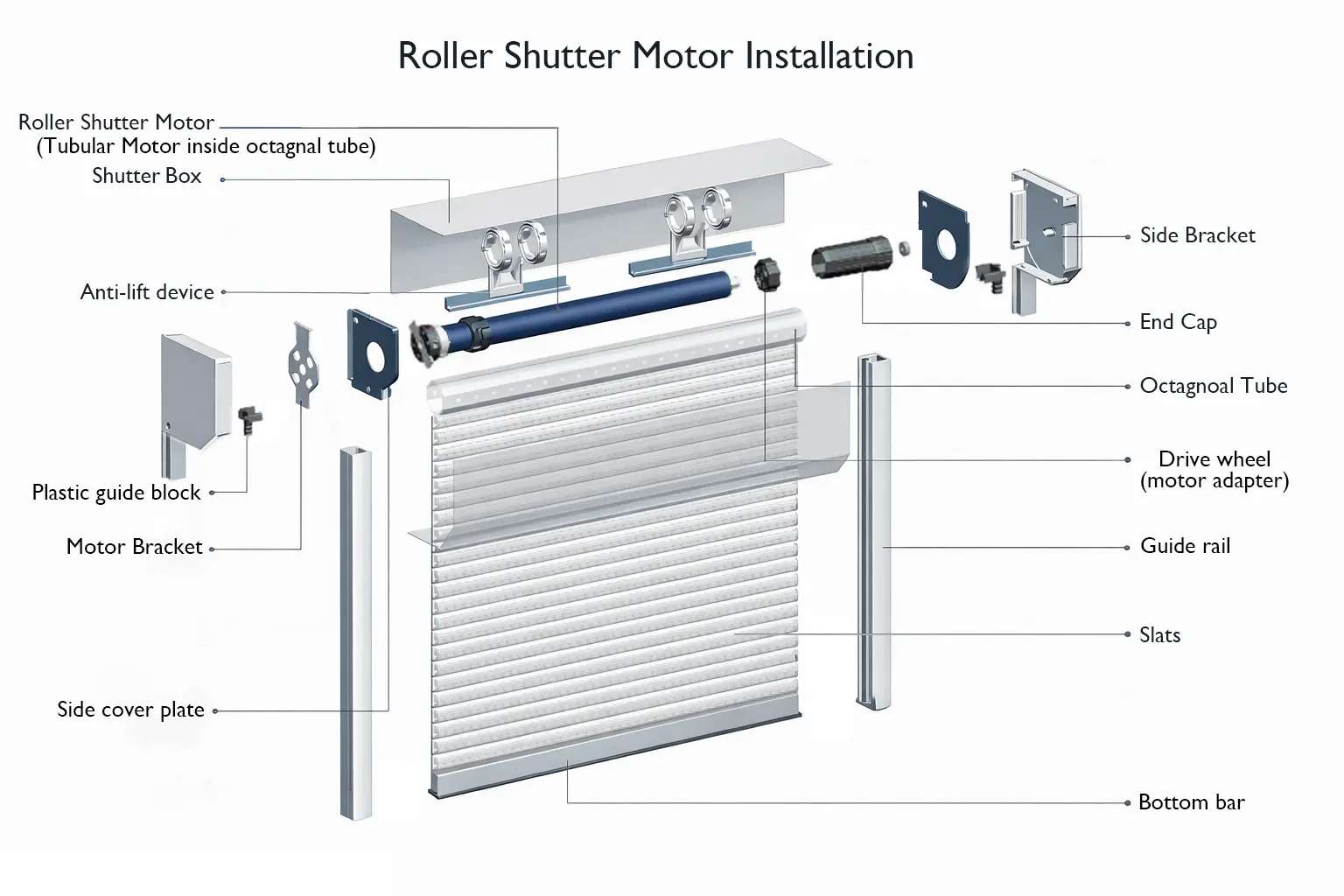
Best for: residential shutters, shopfront shutters, commercial shutter doors and rolling shutter systems.
Main question: Can the motor lift the shutter safely, repeatedly and with enough torque margin?
Open Roller Shutter Motor Buying Guide ->Roller Blinds Motor
Best for: indoor roller blinds, battery blinds, AC blinds and smart shading products.
Main question: Is the motor quiet, compact, easy to install and compatible with the blind tube?
Open Roller Blinds Motor Buying Guide -> View Roller Blinds Motor Models ->Projection Screen Motor
Best for: home theater screens, meeting rooms, classrooms and commercial projection screen systems.
Main question: Can the motor stop accurately and run quietly without damaging the screen fabric?
View Projection Screen Application ->Zip Screen / Zip Blinds Motor
Best for: outdoor zip screens, side-channel shading systems and wind-exposed applications.
Main question: Is there enough torque margin for fabric tension, guide rail friction and outdoor resistance?
View Zip Screen Motor ->Venetian Blinds Motor
Best for: motorized Venetian blinds where lifting and slat angle control are important.
Main question: Can the motor and control system support precise light adjustment and stable operation?
View Venetian Blinds Motor ->Awning Motor
Best for: folding arm awnings, outdoor shade systems and weather-exposed installations.
Main question: Does the motor match the awning size, outdoor load, control system and emergency operation requirement?
View Awning Motor ->Rolling Garage Door Motor
Best for: rolling garage doors and rolling shutter door applications that use a tubular drive structure.
Main question: Is the door a rolling shutter structure or a sectional garage door opener system?
View Heavy-Duty Shutter Motors ->Remote Control and Controller
Best for: RF remote control, wall switch, receiver, Wi-Fi, Zigbee and smart home control planning.
Main question: Which control system should be matched with the motor before sample approval?
View Controllers ->Accessories
Best for: crowns, drive wheels, brackets, adapters, end caps and installation accessories.
Main question: Will the motor fit the tube, bracket and installation system used in your market?
View Accessories ->Important Note About Rolling Garage Door Applications
Walter Motor can support motor selection for rolling garage doors and rolling shutter doors that use a tubular motor structure. If your project is a sectional garage door opener, the drive structure is different and should be confirmed separately before quotation.
What Buyers Should Confirm Before Ordering
Application
Confirm whether the motor is for shutter, blind, screen, awning, projection screen, Venetian blind or rolling door use.
Load and Size
Check curtain weight, shutter weight, tube diameter, width, height and expected torque margin.
Motor Configuration
Review motor diameter, torque, speed, voltage, limit system, duty cycle and manual override requirement.
Control Method
Choose switch control, built-in receiver, RF remote, wall switch, dry contact, gateway or smart home control.
Accessory Fit
Match crown, drive wheel, bracket, adapter, end cap, cable exit and installation dimensions.
Market Readiness
Confirm certification needs, label language, packaging, plug, cable length, MOQ, lead time and after-sales documents.
Compare Motor Types Before Sample Approval
| Motor / Control Type | Best For | Main Buying Concern |
|---|---|---|
| Mechanical Limit Motor | Standard shutters, blinds and awnings | Simple installation, clear limit adjustment and serviceability |
| Electronic Limit Motor | Projects needing accurate limit setting | Reset process, installer training and controller compatibility |
| Built-in Receiver Motor | Remote-controlled blind and shutter systems | Remote matching, frequency, signal range and channel planning |
| Battery Motor | Compact indoor roller blinds | Charging method, solar option, runtime and user convenience |
| Manual Override Motor | Commercial shutters, awnings and power-failure risk applications | Emergency operation, gear structure, crank position and installation access |
| Smart Control System | App control and smart home projects | Gateway, protocol, market compatibility and user setup process |
Different Buyers Should Start From Different Questions
| Buyer Role | Start From | Avoid This Mistake |
|---|---|---|
| Importer | Product range, certificates, MOQ, lead time and stable supply | Only comparing unit price without confirming configuration |
| OEM Brand | Motor family stability, private label, packaging and repeat orders | Changing motor parameters after sample approval |
| Roller Shutter Company | Torque, tube, bracket, manual override and site safety | Selecting torque without real shutter weight and tube size |
| Blind Manufacturer | Noise, tube size, compact design and remote control matching | Oversizing the motor and increasing cost unnecessarily |
| Project Contractor | Installation conditions, wiring, documentation and after-sales risk | Ignoring site conditions before ordering |
| Purchasing Manager | Clear RFQ details, target price, delivery plan and market requirements | Asking for price before defining the application |

Use These Walter Buying Guides for Deeper Decisions
Tubular Motor Buying Guide
Use this guide when you need a broader view of tubular motor selection, including motor diameter, torque, voltage, limit system, control method, tube compatibility and OEM purchasing requirements.
Go to Tubular Motor Buying Guide ->Roller Shutter Motor Buying Guide
Use this guide when your main product is a roller shutter, rolling shutter door or shutter system. It focuses on torque, tube and bracket compatibility, manual override, control options, safety, certification and RFQ preparation.
Go to Roller Shutter Motor Buying Guide ->Roller Blinds Motor Buying Guide
Use this guide when your main product is a roller blind, roller shade, zebra blind, smart shade or indoor shading system. It covers motor size, torque, power, smart control, tube fit, safety and RFQ preparation.
Go to Roller Blinds Motor Buying Guide ->Send These Details for a Faster and Cleaner Quotation
A complete RFQ helps Walter Motor recommend the right motor, control system and accessories with fewer back-and-forth questions. Before asking for price, please prepare as many details as possible.
- Application: roller shutter, roller blind, projection screen, zip screen, Venetian blind, awning or rolling door
- Tube diameter, tube profile and installation space
- Curtain, shutter or fabric weight
- Product width, height and travel distance
- Required torque and speed, if already known
- Voltage and frequency requirement
- Limit system: mechanical or electronic
- Control method: switch, RF remote, built-in receiver, Wi-Fi, Zigbee, gateway or other system
- Manual override requirement
- Accessories required: crown, drive wheel, bracket, adapter, end cap or special part
- Target market and certification requirement
- OEM label, private label, packaging or carton mark requirement
- Quantity, sample requirement and expected delivery time
Not sure which motor to choose?
Send your application, tube size, product weight, voltage, control method and target market. Walter Motor can review the basic configuration before quotation.
Send RFQ to Walter MotorCommon Buying Mistakes to Avoid
Choosing by Price Only
A lower price may become expensive if the motor is undersized, the accessory does not fit, or the control system is not compatible with the market.
Ignoring Tube Compatibility
The crown, drive wheel, bracket and tube profile should be confirmed before sample approval, especially for OEM customers and project orders.
Forgetting Control Matching
Remote control, receiver, frequency, wall switch and smart gateway requirements should be confirmed together with the motor, not after production.
Unclear Certification Requirement
Different markets may require different documents, labels, voltage settings or packaging information. These should be discussed before mass production.
No Manual Override Plan
For commercial shutters, awnings and some rolling door applications, emergency operation during power failure may be an important safety and service requirement.
Incomplete RFQ
If the RFQ only asks for price without application, size, tube, load and control details, the quotation may not reflect the real motor configuration needed.
Frequently Asked Questions About Motor Buying
What should buyers confirm before choosing a motor?
Buyers should confirm the application, tube diameter, curtain or shutter weight, required torque, speed, voltage, control method, limit type, accessory requirements, target market, certification needs and OEM packaging requirements before asking for a final quotation.
Should I choose by application or by motor diameter first?
Application should come first. Motor diameter is important, but the application decides load, operating environment, safety requirements, control method and accessory matching. After the application is clear, the proper motor diameter and torque range can be reviewed.
Can one motor family be used for different shading products?
Some motor families can support several products such as roller blinds, roller shutters, awnings, zip screens and projection screens, but the final configuration depends on torque, speed, tube size, limit system, noise requirement, accessories and control method.
When is manual override necessary?
Manual override is usually important for commercial roller shutters, shopfront shutters, outdoor awnings and applications where operation may be needed during a power failure. For small indoor blinds, manual override is normally not required.
Do remote controls and motors need to be matched before ordering?
Yes. Remote control type, receiver type, frequency, channel quantity, wall switch, gateway and smart control requirements should be confirmed before sample approval and mass production.
What information helps Walter Motor prepare a faster quotation?
A complete RFQ should include application, tube size, product weight, torque or size target, voltage, control method, accessories, certification requirement, OEM label or packaging request, target market, quantity and expected delivery plan.

