
Roller Blinds Motor Torque
Roller Blinds Motor Torque Guide
How to choose the right torque for roller shades, roller blinds and motorized window coverings
Roller blinds motor torque depends on blind size, fabric weight, tube diameter, friction, usage frequency and safety margin. Do not select only by blind width.
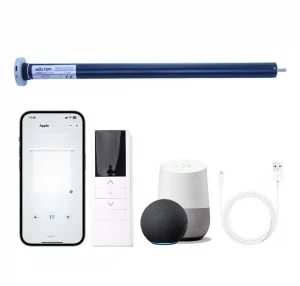
Quick Answer: How Much Torque for Roller Shades?
- Small roller shades may use 1.1Nm motors.
- Medium roller blinds often use 3-6Nm motors.
- Large or heavy blinds may need 10Nm or above.
- Final selection should consider fabric weight, tube diameter, friction and application conditions.
- Do not select only by blind width.
What Does Roller Blinds Motor Torque Mean?
Torque is the turning force available at the output tube. In roller blinds, it must overcome fabric load, bottom bar weight, tube radius and system friction so the shade moves smoothly without overload.
Practical Torque Selection Table
| Application | Typical Tube | Suggested Load Range | Common Torque | Typical Motor Diameter | Buyer Note |
|---|---|---|---|---|---|
| Small interior roller shades | Narrow tube | Light fabric and small size | 1.1Nm class | 25mm | Confirm tube compatibility. |
| Standard residential roller blinds | Standard roller tube | Medium residential fabric | 3-6Nm | 35mm | Check fabric and bottom bar. |
| Large blackout blinds | Larger tube | Heavier fabric and wider blind | 6-10Nm | 35mm or 45mm | Avoid selecting by width only. |
| Commercial roller shades | Project tube | Frequent operation or larger fabric | 10Nm or above | 45mm | Review duty cycle and noise. |
| Heavy-duty or outdoor roller blinds / zip screen-like application | Application-specific tube | Higher load and friction | Project-based | 45mm or larger | Confirm with actual project data. |
Final selection should be confirmed by actual fabric weight, tube size and installation conditions.
Key Factors That Affect Torque
Blind width and height
Width and drop define the fabric area and bottom-bar load. Large blinds also create more tube deflection and friction.
Fabric weight
Fabric weight in g/m² should be converted into total load together with the bottom bar and any sewn pocket or rail.
Tube diameter
Tube radius is part of the torque calculation. A larger tube can require more turning force for the same load.
Fabric roll diameter
The effective radius changes as fabric rolls up. Heavy fabrics on large blinds need enough margin near the largest roll diameter.
Bearing and bracket friction
Poor brackets, tight side clearance or rough bearings can increase real load beyond the simple weight calculation.
Usage frequency
Frequent daily operation needs a motor range that can handle heat and duty cycle, not only one successful lifting test.
Installation angle or special structure
Non-standard cassette, side channel, outdoor mounting or zip-screen-like friction should be treated as project-specific.
Safety margin
Safety margin is the extra allowance after the efficiency-adjusted calculation; it is not the same as system efficiency.
Fabric Weight Reference
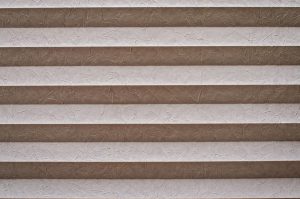
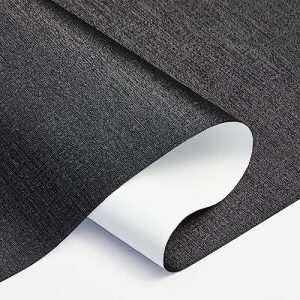
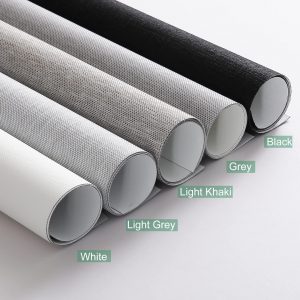
| Fabric Type | Typical Weight | Application | Torque Impact |
|---|---|---|---|
| Zebra fabric | Light to medium | Residential day-night blinds | Lower to medium torque demand. |
| Dim-out fabric | Medium | Residential and light commercial | Medium torque demand. |
| Sunscreen fabric | Medium, varies by openness | Sun control roller shades | Check width and tube radius. |
| Blackout fabric | Medium to heavy | Bedrooms, hotels and offices | Higher torque may be needed. |
| Heavy-duty fabric | Project-specific | Large or special systems | Confirm with sample weight and installation. |
Engineering Torque Calculation
Required torque ≈ load weight × 9.81 × tube radius / system efficiency.
System efficiency is the allowance for losses from tube rotation, brackets, bearings, fabric rolling and friction. Safety margin is the additional allowance applied after the efficiency-adjusted result. They should not be treated as the same number.
This is an engineering estimate for selection discussion, not a universal guarantee. Final motor choice should be confirmed with actual fabric data, tube profile, installation condition and project duty cycle.
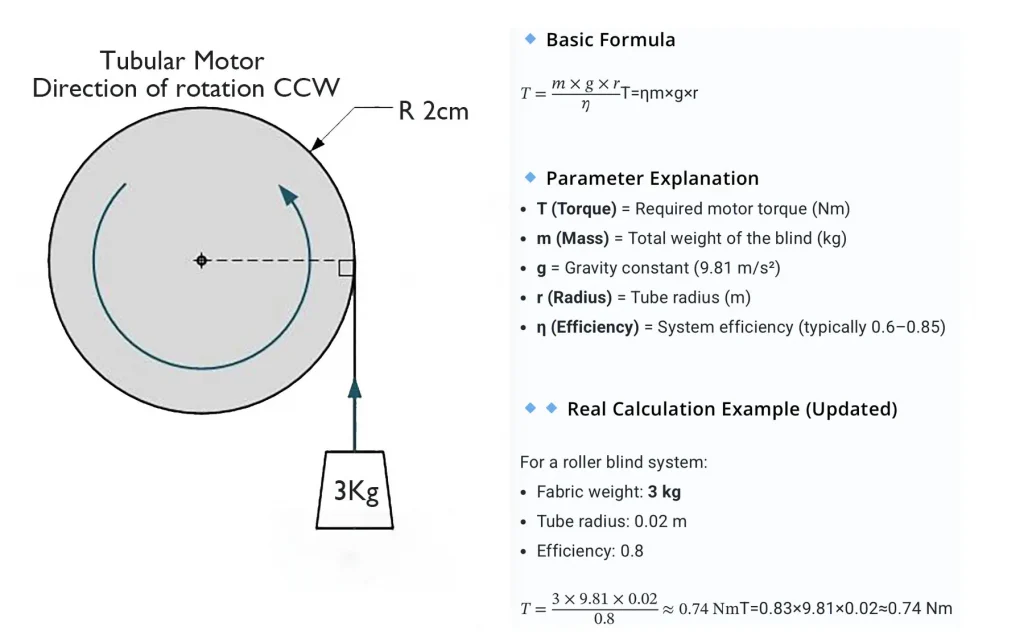
Worked Example: 3kg Roller Shade Load
For a 3kg combined fabric and bottom-bar load, 0.02m tube radius and 0.8 system efficiency: 3 × 9.81 × 0.02 / 0.8 ≈ 0.74Nm. The next suitable motor range may be 0.8Nm or 1.1Nm, depending on friction, tube fit, usage frequency and project safety margin.
This result should not be applied to all roller shades. Large blackout fabrics, outdoor use, tight side channels, poor brackets or frequent operation may require a higher motor range.
Why Too Low or Too High Torque Is a Problem
If torque is too low
The blind may not lift smoothly, may overheat, may show limit instability and may have shorter service life.
If torque is too high
The buyer may pay unnecessary cost, need a larger motor, face noise or speed mismatch, or have small tube compatibility issues.
Motor Size Recommendation
| Motor Series | Typical Torque | Suitable Roller Blind Application | Notes |
|---|---|---|---|
| WM25 / 25mm series | Low torque class | Small roller shades and narrow tubes | See WM25BR roller shade motor. |
| 35mm series | Medium torque class | Standard residential blinds | See YYGL35S. |
| 45mm series | Medium to higher torque class | Large blackout blinds and project shades | See YYGL45S. |
RFQ Checklist for Torque Selection
| RFQ Field | What to Provide | Why It Matters |
|---|---|---|
| Blind width | Finished width or project module width | Needed to estimate fabric area and tube selection. |
| Blind height | Finished drop / travel height | Affects fabric weight and roll diameter. |
| Fabric weight g/m² | Actual fabric data sheet value | Do not estimate only by fabric type name. |
| Bottom bar weight | Weight per piece or per meter | Often missed in small-blind torque estimates. |
| Tube OD/profile | Outside diameter and tube profile drawing or sample | Determines motor diameter, crown and drive wheel. |
| Indoor/outdoor use | Indoor, semi-outdoor or exposed condition | Outdoor friction and wind-related load may change selection. |
| Usage frequency | Cycles per day or project duty requirement | Helps avoid overheating in high-use projects. |
| Voltage | AC mains, DC low voltage or battery | Controls motor series and wiring method. |
| Control method | Wall switch, remote, receiver, smart system or project controller | Affects motor type and accessories. |
| Quantity | Sample, pilot batch or mass order | Needed for pricing, planning and OEM support. |
| Destination market | Country or region | Helps confirm voltage, frequency and compliance needs. |
Walter Selection Support
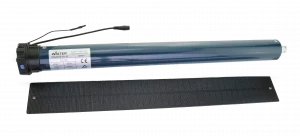
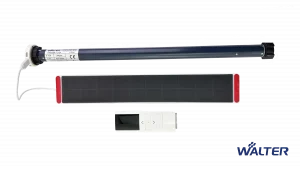
Walter can review project data and recommend motor torque, motor diameter, control type, tube adapter and battery or AC option for OEM buyers. The most accurate recommendation comes from real load data rather than only blind width.

FAQ
What torque motor do I need for roller blinds?
The required torque depends on blind size, fabric weight, tube diameter, friction, usage frequency and safety margin. Small blinds may use compact low-torque motors, while larger blinds need higher torque.
How much torque for roller shades?
Small roller shades may use 1.1Nm motors, medium roller blinds often use 3-6Nm motors, and large or heavy blinds may need 10Nm or above.
Is 1.1Nm enough for roller blinds?
It can be enough for small and light roller shades, but it should not be selected only by blind width. Fabric weight, tube diameter and friction still matter.
When should I use 3Nm or 6Nm?
3Nm or 6Nm motors are often used for standard residential roller blinds where the tube, fabric and installation load fit that range.
Can I use a higher torque motor?
A higher torque motor may work, but it can add cost, require a larger tube or create speed and noise mismatch in small systems.
Does tube diameter affect torque?
Yes. Tube radius changes the torque needed to rotate the fabric roll, especially as fabric weight and roll diameter increase.
Does fabric weight affect motor torque?
Yes. Heavier blackout or commercial fabrics usually require more torque than lightweight zebra or sunscreen fabrics.
How do I calculate roller blinds motor torque?
A practical estimate is required output torque equals load weight times gravity times tube radius divided by system efficiency, with a reasonable safety margin.
What motor size is used for small roller shades?
Small roller shades commonly use compact 25mm motors when the tube and load are suitable.
Can Walter help calculate torque for OEM projects?
Walter can review blind size, fabric type, tube diameter, quantity, voltage, control method and usage conditions to recommend a suitable motor range.

